


Toyota Tacoma vs Tundra
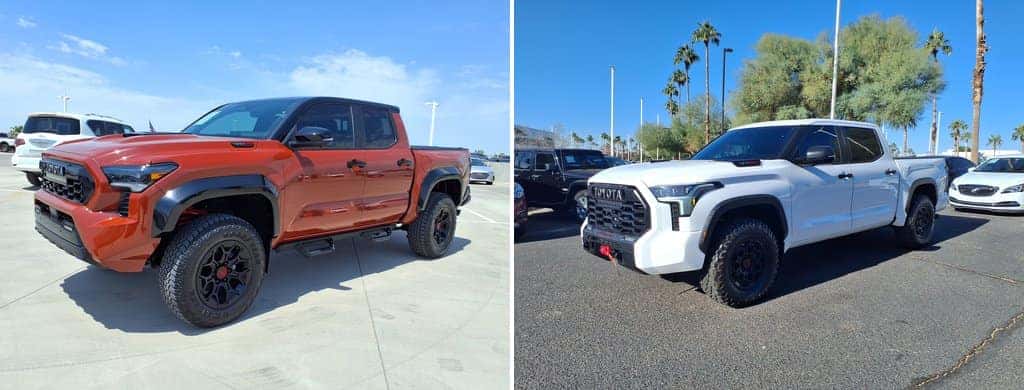
In South Georgia, a pickup isn’t just a vehicle. It pulls the boat to the Flint River, hauls feed and fencing, gets you down a sandy field road during peanut harvest, and still has to be comfortable enough for the drive to church on Sunday. If you’ve narrowed it down to Toyota, the next question is usually the big one: Toyota Tacoma vs. Tundra? Here’s an honest, side-by-side look from the team at Hutchinson Toyota of Albany to help drivers in Albany, Cordele, Tifton, Americus, Leesburg, Sylvester, Dawson, and across South Georgia choose the right truck.
The Short Version: Tacoma or Tundra?
- Choose the Tacoma if you want a truck that’s easy to drive and park every day, handles light-to-moderate towing, and shines on trails and dirt roads.
- Choose the Tundra if you regularly tow heavy trailers, haul big loads, need more cabin space for a crew or family, or want the comfort of a full-size truck on long highway drives.
The rest of this guide breaks that down so you can match the truck to the work you actually do.
Size and Everyday Driving
The Tacoma is a midsize pickup, and that’s a real advantage for a lot of drivers. It fits more easily in a standard garage, is simpler to maneuver in a crowded parking lot on Dawson Road, and feels nimble on narrow farm lanes and wooded hunting tracts. For drivers who use their truck as a daily commuter first and a work vehicle second, that everyday ease matters.
The Tundra is a full-size pickup. It takes up more space, but it gives you a roomier cabin, a smoother ride on long highway stretches, and a planted, confident feel when you’re loaded down. If you regularly drive the highway to Atlanta or Jacksonville, or spend long days in the truck, the extra size pays off in comfort.
Towing and Hauling
This is where the two trucks separate the most. When properly equipped, the Tacoma can tow up to 6,500 pounds, which covers most bass boats, pontoon boats, utility trailers with a mower or side-by-side, and small campers.
The Tundra, properly equipped, can tow up to about 12,000 pounds. That puts larger travel trailers, loaded equipment trailers, livestock trailers, and bigger boats within reach. It also offers more payload capacity for loading the bed with feed, fertilizer, or building materials.
A good rule of thumb: if you’ll be towing close to the Tacoma’s limit on a regular basis, the Tundra will do the same work with less strain and more confidence. Actual ratings vary by configuration, so our sales team can confirm the exact numbers for the truck you’re considering.
Farm, Field, and Hunting Season
Both trucks are available with four-wheel drive and off-road-focused trims, but they approach rough terrain differently. The Tacoma has long been one of the most capable off-road trucks in its class. Trims like the TRD Off-Road and TRD Pro add equipment built for mud, sand, and uneven ground, and its smaller size makes it easy to thread between pecan trees or down a tight trail to a deer stand.
The Tundra is at its best when capability means strength: pulling a loaded trailer out of a wet field, hauling a heavy load down a dirt road, or making daily runs between the farm and the co-op. It offers its own TRD Pro trim for drivers who want full-size strength with serious off-road hardware.
Engines and Fuel Economy
The current Tacoma uses a turbocharged four-cylinder engine that delivers strong low-end pulling power, with the Tacoma i-FORCE MAX hybrid powertrain available for even more torque. The Tundra steps up to a twin-turbo V6, and the Tundra i-FORCE MAX hybrid is the most powerful option in the lineup.
In general, the smaller Tacoma uses less fuel in everyday driving, which adds up for drivers putting a lot of miles on their truck. The Tundra’s efficiency is competitive for a full-size pickup, and the hybrid versions of both trucks help with fuel use in stop-and-go driving around town.
Cab, Bed, and Comfort
The Tacoma is offered with a two-door XtraCab and a four-door Double Cab, with bed lengths of about five or six feet. The Double Cab works well for small families and occasional passengers.
The Tundra comes in Double Cab and the spacious CrewMax, with bed lengths from about five and a half feet up to just over eight feet. If you carry adults in the back seat regularly or need a long bed for plywood and lumber, the Tundra gives you more room to work with. Upper trims of the Tundra, like the Limited, Platinum, and 1794 Edition, also add a level of interior comfort that makes it a true daily driver for families.
Which Truck Fits Which Driver?
- The commuter who hunts and fishes on weekends – The Tacoma is easy to live with during the week and ready for the woods on Saturday.
- The farm or ranch owner – The Tundra’s towing capacity and payload handle equipment, livestock, and supply runs.
- The family that tows a camper or big boat – The Tundra CrewMax offers space for everyone plus the strength to tow with confidence.
- The trail and off-road enthusiast – A Tacoma TRD Off-Road or TRD Pro is built for exactly this.
- The small business owner or contractor – Either can work. Choose based on how much weight you haul and tow each week.
Why Buy Your Truck From Hutchinson Toyota of Albany
The best way to decide is to drive both, ideally back to back. Our team will help you compare configurations, confirm towing and payload numbers for the way you’ll use the truck, and find the right match in our inventory. And once it’s yours, our service department is here to keep it working as hard as you do.
Everything we do is backed by the Hutchinson Advantage, our commitment to honest, no-pressure service for truck buyers in Albany, Cordele, Tifton, Americus, Leesburg, Sylvester, Dawson, and throughout South Georgia.
Find Your Toyota Truck in Albany
Tacoma or Tundra, we’ll help you find the truck that fits your work, your weekends, and your budget. Stop by Hutchinson Toyota of Albany to test drive both.